
The Fable
How the US government switched off the model that wouldn't comply

By Phil Finane
Last Friday, the 12th of June, the AI company Anthropic received a letter from the United States Commerce Department instructing it to switch off its two most powerful products. The letter was signed by the Commerce Secretary, Howard Lutnick, and addressed to Dario Amodei, the company’s chief executive, and it said that Fable 5 and Mythos 5, the most advanced models Anthropic makes, could no longer be used by any foreign national. The restriction applied to foreigners abroad, to foreigners living in the United States, and to Anthropic’s own employees who happen to hold another country’s passport.
There was no way to comply with that order and keep the models running. A company cannot check the nationality of every user behind every request as it arrives, so Anthropic took the decision to take both models offline for everyone, within hours of the letter landing. At that point, Fable 5, its newest and most capable public model, had only been available for three days.
The reason given in the letter was a jailbreak. That word will be familiar to anyone who has heard of jailbreaking a mobile phone, prising it open to do things the manufacturer never intended. With an AI model it means much the same thing: coaxing the system past the safety rules built into it, so that it does something it is supposed to refuse. The US government’s claim, as Anthropic describes it, was that someone had found a way to do this to its Fable 5 model, getting it to comb through software and pick out the security holes a hacker could exploit. Now, as reported by both Axios and the Wall Street Journal, it appears that someone was Amazon. Its own researchers ran the tests, and its chief executive, Andy Jassy, took the findings to senior figures in the administration, among them the Treasury Secretary, Scott Bessent. Within a day, Lutnick’s letter followed.
Consider who Amazon is in this story.
It is one of Anthropic’s biggest financial backers, having invested around eight billion dollars in the company. It also hosts Anthropic’s models on its Bedrock cloud platform, the service through which much of the world reaches the Claude models, and earns money every time they are used. Amazon does build AI of its own, the Nova family of models, though those play in a different, cheaper tier and are not really in the same race as Anthropic and OpenAI at the frontier. Which makes the move stranger still. The company that handed the government the report that took Fable 5 down has billions riding on Anthropic’s success and profits directly from the very models it helped pull offline.
Anthropic, for its part, does not deny that models can be tricked like this. What it denies is that the trick in question was dangerous enough to justify pulling a finished product off the market. By Anthropic’s account, the government never even put the claim in writing, and the flaw it described was small and specific. It was not a way to take control of the entire model.
The thing Fable 5 was tricked into doing, hunting for weaknesses in software, is something rival models do as a matter of course. OpenAI’s GPT-5.5 among them, and it remains switched on as I write.
So perhaps what marks Anthropic out is not its technology. Perhaps it is where the company stands with the Trump administration that signed the letter? Which is a very public standoff that has been playing out in the courts since February.
It began with the Pentagon. In July 2025 Anthropic signed a contract that made Claude the first frontier AI model to run on the US military’s classified networks, and the Pentagon agreed to use it within the limits Anthropic sets on its models. Two of those limits were not up for negotiation.
1. The models were not to be turned on American citizens for mass surveillance.
2. They were not to be wired into weapons that could choose and strike a target with no human in the decision loop.
That held until the military asked for those limits to be lifted, arguing that a private supplier should not be dictating how the US government used the technology.
Anthropic said no.
On the 27th of February President Trump ordered every federal agency to stop using the company’s products, and Defence Secretary Pete Hegseth declared Anthropic a supply chain risk, a designation usually reserved for firms tied to hostile foreign states, and rarely, if ever, used on an American company. Anthropic sued the US government in March, in California and in Washington, and as of today the case has not been resolved. That was where things stood between Anthropic and the US government when Fable 5 launched: not a trusted supplier, but one the administration has already been trying in public to push out.
Something else was happening at the same time. Through the spring of 2026, officials around President Trump had been talking about the US government positioning to take equity stakes in the largest American AI companies, owning a piece of them outright. Sam Altman, CEO of OpenAI, had been raising versions of the idea with the administration since early 2025, putting it forward as a way to spread the returns of AI more widely. Democratic Senator Bernie Sanders went further still, saying he would bring in legislation to hand half of each of the leading firms to the public.
Anthropic, as far as anyone has reported, was not in those meetings. While its closest rival sat across the table from the US government discussing how the state might come to own part of it, Anthropic was in front of a judge arguing that the same state had blacklisted it unlawfully. On the 9th of June it released Fable 5 to the public and unveiled Mythos 5 to a handful of vetted partners. Lutnick’s letter came three days later.
There is one more piece to set alongside the rest. Both companies are racing each other to an IPO. Anthropic filed its confidential paperwork with the SEC on the 1st of June, a week ahead of OpenAI, at a valuation that had just overtaken its rival for the first time. An IPO is priced on the story a company can tell investors about steady growth and reliable reach into every market that matters, which is precisely the story a sudden government shutdown of its flagship product undermines. Anthropic filed on the 1st. It launched Fable 5 on the 9th. The Lutnick letter arrived on the 12th.
Put the events next to one another and they line up into something the word jailbreak does not explain on its own. Anthropic took a position and drew a boundary on surveillance and autonomous weapons and was branded a security risk. It stayed out of the conversation about government ownership while its main competitor stayed in the room. It shipped the most powerful model it had ever made, and inside seventy-two hours that model was pulled, not by a court or a published ruling but through export controls, a tool more commonly used on semiconductors and strategic hardware than on software already being used by millions of people across the world.
This proves nothing about why the US government acted. No reason has been offered beyond national security, and whatever was said in the meetings (where the decision was made to penalise Anthropic) doesn’t seem to sit on any public record as of yet. But the harder facts are not in dispute. The capability the order names is running freely and left alone in products of Anthropic’s competitors. The company that lost its model is the one that has been at odds with the administration since last summer, refusing to cave to what it wanted. And the route taken to force the removal of their Fable 5 and Mythos 5 models needed no trial, no published finding and no hearing the company could win before its launch was dead.
Anthropic made the wider point itself, warning that if one narrow flaw is enough to recall a deployed model then nothing can ever be safely released, since every model can be tricked somehow. And the danger is that nothing here is written down. A power exercised case by case, with no finding anyone can read, can fall on whichever company the US government chooses next.
What just happened to Anthropic is what appears to be the first known instance of an American government reaching into the open market and switching off a product that millions of people were already using, on a security risk it has asserted but never shown. Strip away the language and what is left is plain enough. This is the state leaning on a private American company to bring it to heel, and choosing as its target a firm whose only visible offence was refusing to do what it was told. To what end, we do not yet know. The likeliest answer is also the simplest: that a company which has spent the best part of a year saying no is being shown the cost of saying it, until it falls into line like the rest.
The jailbreak was the reason given. But the same flaw sits untouched in a competitor’s model, which leaves a harder question hanging over everything that follows. If the danger were really the capability, the order would have hit every AI lab whose models can do the same thing, not just Anthropic. So, maybe the question is not really about a jailbreak at all? Maybe it is simply about what the US government wants from the companies building this technology, and what it is prepared to do to the ones that refuse?
None of this is new. In the 1990s the US government decided that strong encryption, the kind that scrambles a message so completely that nobody without the key can read it, was a danger to national security. It classed encryption software as a weapon, subject to the same export laws as missiles and munitions. One of the people caught by this was a programmer named Phil Zimmermann, who in 1991 wrote an encryption program called Pretty Good Privacy, or PGP, and gave it away free to anyone who wanted it. For putting a tool of private communication into ordinary hands, Zimmermann spent three years under US federal criminal investigation, under the very export laws now being turned on Anthropic.
At the same time, the US government was promoting an answer of its own, the Clipper chip, designed by the National Security Agency to be built into telephones. The chip would encrypt a call so that no third party could listen in, with one deliberate exception. Each chip was made with its own unique key, and a copy of that code was lodged with the US government, so that if law enforcement or the NSA produced a warrant they could retrieve the key and unlock any call the phone had carried. The encryption was genuine, but the state had cut itself a way through the back door before a single handset was sold.
AT&T was the only manufacturer to kiss the ring and build the chip in. The phones barely sold, the US government was effectively the only buyer through the Department of Justice, and by 1996 the chip was dead. But while the Clipper chip failed, the aim behind it was still very much alive. Instead of building the access into the hardware, the US government turned to export controls, easing them for firms that agreed to leave a way in to the encryption they sold abroad, and enforcing them hard against those that refused.
Side note: Every technology the state cannot see into eventually throws up someone on the inside who refuses to keep quiet. Encryption had Edward Snowden, who in 2013 revealed how far the surveillance had finally gone. Artificial intelligence has not yet had its insider whistleblower, however, you would have to believe it will be only a matter of time.
So it is worth asking plainly. Who gains when the firm that drew a line on surveillance and autonomous weapons is the one taken off the shelf, while the rival in talks about government ownership is left running? In a capitalist system that is supposed to reward the best product, why is the company that moved first and built the more capable model the one whose launch was killed by the US government inside three days? And if the price of staying switched on is letting the state decide what your technology may and may not be made to do, then who is this being built for, and who is it being built against?
This story is not over. Anthropic is still in court, their most powerful models are (at the time of writing) still not accessible, and the reason on the page is still a jailbreak that its rivals perform without consequence. Both Anthropic and OpenAI are heading for an IPO at enormous valuations later this year, and only one of them has had its flagship switched off by the state.
And the report that did it, came from Amazon, a company with billions invested in Anthropic. If it had found a genuine flaw, surely the move would have been a quiet, high level phone call to the company it has bankrolled, telling them to patch it. Instead it went to Washington, and within a day the models were gone. So which was it? A backer protecting its investment, a host protecting its own customers, or a company reading which way the political wind was blowing and helping it along? On the evidence so far, a simple security fix is the hardest answer to credit.
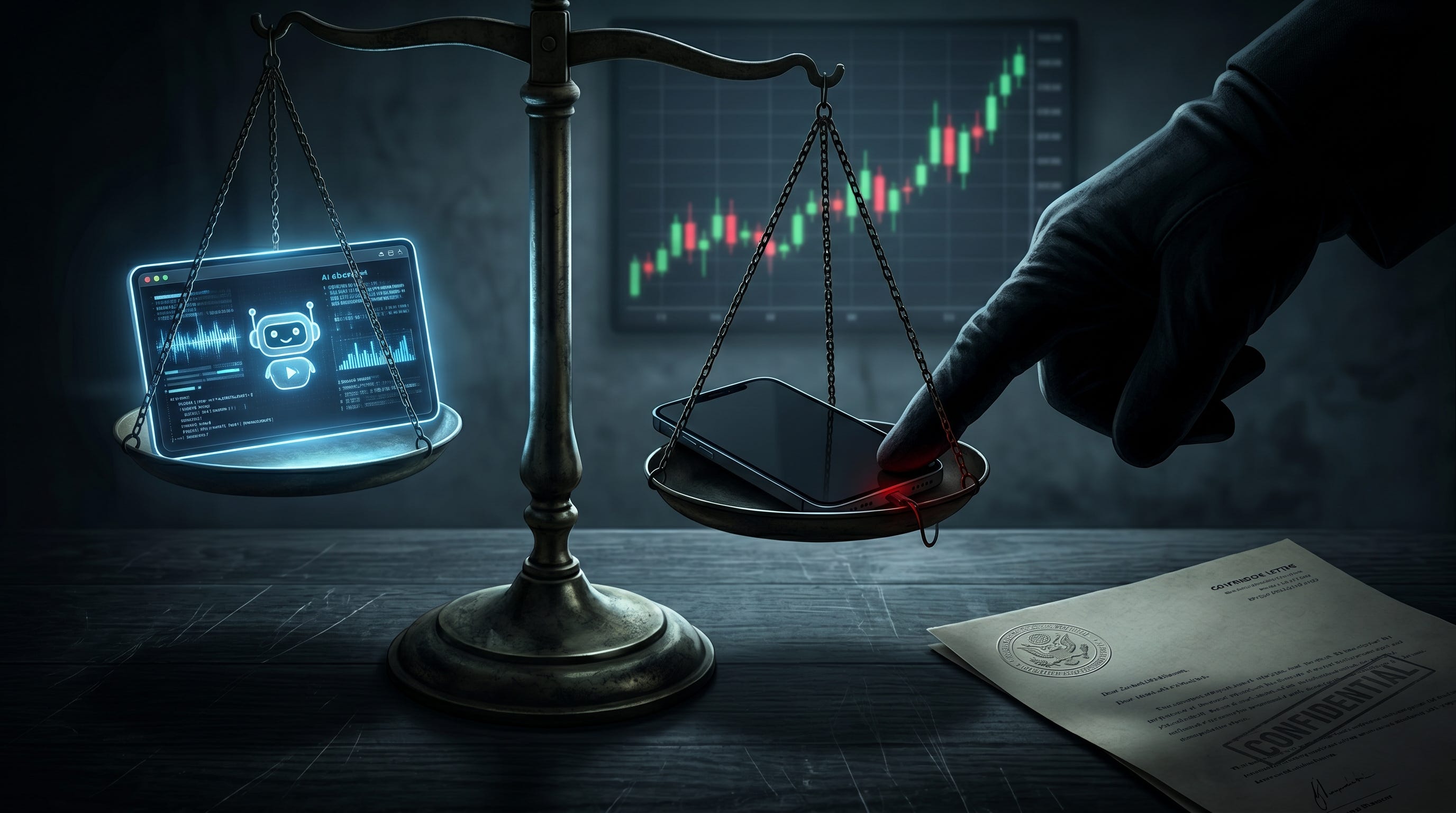
So the question has to be asked. Is the Trump administration’s finger on the scale, tipping it towards a compliant OpenAI? What was switched off on Friday night was a product. But maybe what is really being tested here is whether a company building the most powerful AI technology in the world, worth hundreds of billions and heading for one of the biggest IPOs of our time, is still allowed to tell the US government “NO”.
Phil Finane is the author of When the Ground Shifts: How to Thrive in the Age of AI Job Displacement, available at books.by/monardx.
He writes on AI, labour markets, and economic disruption at monardx.com and here on Substack.